Top fraud detection platform insights: Ad Fraud in 2019

We’ve asked FraudScore’s CPO - Roman Safonov - a couple of questions on how 2019 is already shaping the ad fraud scene, what are the forecasts for the upcoming future and what challenges does FraudScore expect to see:

Roman, tell us in a couple of words about the forecasts that FraudScore gave for 2018? What were they and were they fulfilled?

In general, in 2018 22% of ad traffic that FraudScore analyzed was fraudulent. This means that both mobile and web traffic were vulnerable to fraudsters and that in turn caused at least $27 billion in loses to marketers.

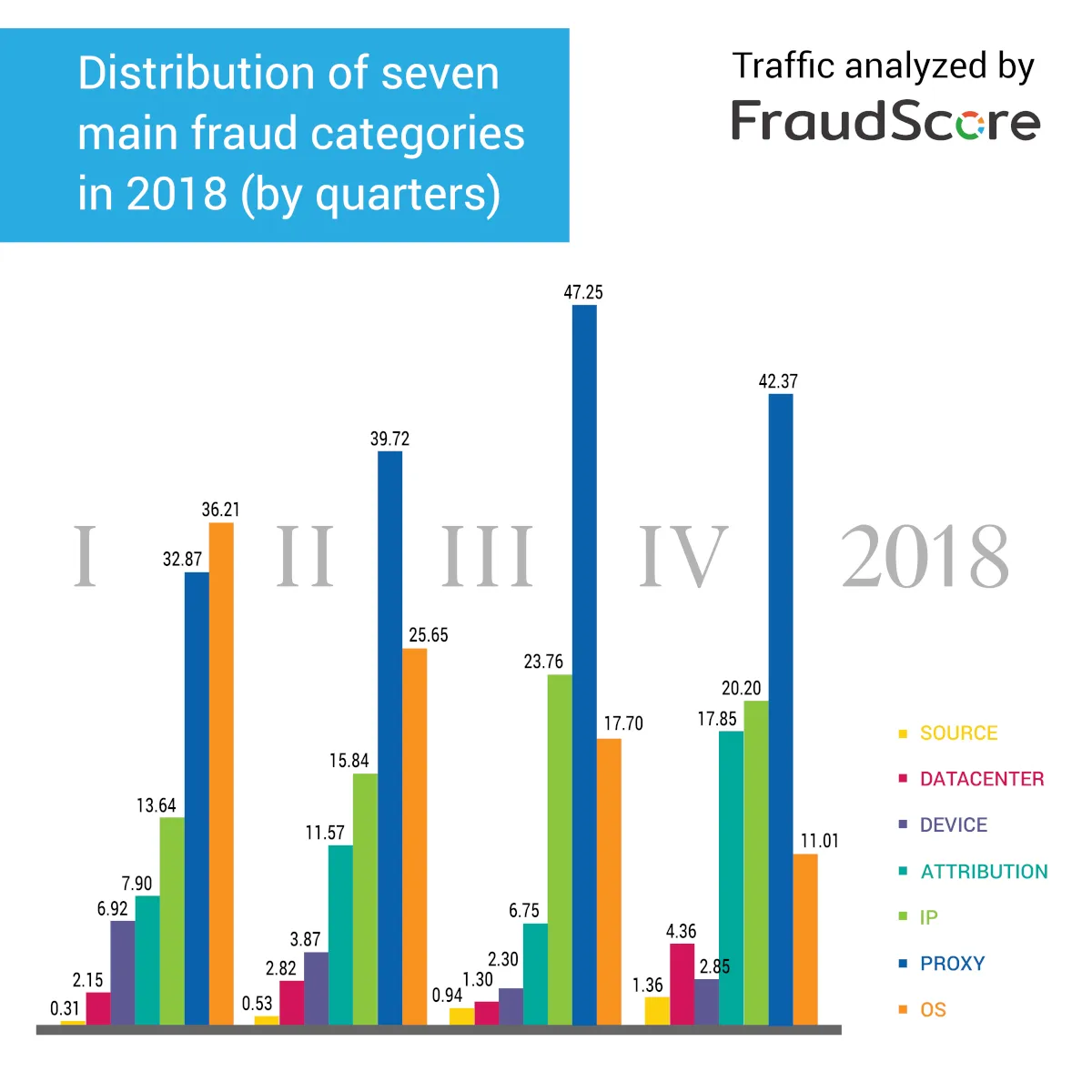
As we’ve already mentioned in our latest report for 2018 that it was a year of botnets. Our forecast at the beginning of 2018 basically reinstated this claim. If we look back - 2017 was the year of attribution fraud, but it goes without saying that the bots are on a continuous rise and will persistently grow in its capabilities. If we take a look at a 2018 timeline - fraudsters had a different approach to the most used fraud types:

What trends did FraudScore see in 2018?

I would say that one of the trends that everybody is speaking about - is the industry’s recognition of ad fraud crime. Global companies are recognizing the problem - Oracle, Google, etc. Governments are accusing fraudsters of committing ad fraud and are issuing real penalties and fines. The problem is being widely talked about. But on the other hand, it leads to the fact that fraudsters get more and more educated, aware, and tech-savvy. They know how the system operates, they are buying and paying for real offers and campaigns to see how they work and find out what the advertisers are paying for. Fraudsters are trying to stay ahead of the curve, they are using ML algorithms and AI to develop ad fraud that is hard to detect. It’s not a secret that they are paying huge money to developers who work on new fraud categories and methods.

There is another trend that started to appear at the end of 2018 and is now completely taking over the market; Fraud detection solutions facing the rise of requirements and capabilities for their products. This means that, on the one hand, fraud detection can no longer be just an evaluation of “fraud” or “not fraud”. It’s obvious to the industry that all parties are dealing with fraud issues and a binary approach in terms of ad fraud detection is no longer an option. On the other hand, fraud detection platforms have to improve more than just their efficiency and also be able to provide more functionalities in fraud detection in order to become even more reliable and to increase their capabilities.

As I have already mentioned, fraudsters are learning and they are learning fast. It goes without saying that fraud detection in 2017 when compared to 2019 are completely different tasks.

And speaking about 2019 - what is FraudScore’s forecast for malware categories? Do you expect drastic changes? What types of fraud are likely to be the most common?

It’s my firm belief that botnets and in-app fraud will be leading the way. Also, it’s worth mentioning that OTT fraud is starting to grow and I think it’s going to shape a strong trend in the second half of 2019. FraudScore is looking in that direction and we’ll be prepared for this new trend.

Speaking about the first quarter of 2019 - Proxy fraud and IP distribution anomalies are the most common types of fraud that were detected by our platform in the past two months (January and February 2019). Our AI algorithms detect mixes and combinations of different fraud reasons and show that bot-fraud is on the rise and is rapidly growing.

We also look at post-install event analysis as it is one of the most prominent trends for 2019. FraudScore sees event reports as a very efficient and highly reliable method for fraud detection. Fraudsters are showing that their approach to stealing ad budgets is always transforming to be one step ahead of the game. I think 2019 is not going to be an exception. It’s all about the speed and reliability of fraud detection solutions that must stay ahead of the fraud game.

Recently, the whole industry has been talking about transparency and the lack of mutual trust in data analysis between advertisers and affiliates? What’s your opinion on that issue?

Advertisers, affiliates, and networks are becoming more mature in terms of ad fraud detection and prevention. The maturity requires transparency - in ad fraud scale, in the quality of sources and the reasons for conversion rejection. More and more companies are turning to third-party ad fraud detection solutions. This trend started to shape in 2018 and we hope that it’ll be the main outlook for 2019.

But, to be honest, the share of the industry’s players that still prefer to stay blindsided to ad fraud is rather big. It means that there are still cases when fraud is “accepted” for various reasons - fear to lose a contract, fraud isn’t noticed by advertiser, reluctance to go to arbitration, etc. Such solution providers as FraudScore are there to break the ice between partners - advertisers and affiliates - and to help them understand that ad fraud is a real crime but it can be dealt with. So transparency is vital - it means that companies are ready to get armed and to resist fraudsters.

And as a FraudScore CPO - can you share your approach towards transparency?

FraudScore is an independent solution - we are a third party product that stays completely transparent about one issue - is there fraud in traffic? FraudScore doesn’t take anyone’s side - our core goal is to detect fraud. It’s vital that we stay transparent with our customer - is there fraud, what are the detected fraud categories, and why this traffic is marked “fraudulent”. We stick to one simple principle - our customer is not a fraud-detection guru, so we need to give a detailed and transparent explanation as to why each particular conversion is fraudulent.

FraudScore is not just a solution that gives traffic check-ups and evaluation - “this is fraud” and “this is not fraud”. FraudScore goes deeper and gives transparent and in-depth reports to our customers about each and every conversion, source, campaign - if it is subject to fraud, what are the fraud categories and reasons. Fraud detection shouldn't break contracts between advertisers and affiliates, it should help them tackle problematic sources and remove problems the moment they appear. Fraud detection is not about a binary approach - fraud or not fraud, it’s about the improvement of traffic quality and helping advertisers and affiliates build long-lasting trustworthy relations.

What do you think about standardization of fraud detection? A lot of recent news have been devoted to standards that the industry needs to establish in order to stay ahead of fraudsters?

I think the major and most common standard is to use ML and AI in fraud detection - as fraudsters are becoming more tech-sophisticated, the capacity to detect fraudulent patterns the moment they appear is the most valuable resource for fraud detection company. Fraudsters know how the industry operates in general, they are able to bypass most common fraud detection patterns. I advise that marketers get armed with those solutions that are using the latest technologies and are able to provide trial checkups so that the marketers can compare various solutions and their approach to fraud detection. Look at ad fraud detection solutions as you look at vaccination - it’s always better to have immunity beforehand than to suffer the consequences after you’ve already gotten sick.

What are FraudScore’s plans for the upcoming future? What updates and news are you going to present in 2019?

FraudScore’s approach in 2019 is to cover all the steps of the marketing funnel - to prevent, detect, reject, and provide post install/conversion event analysis for an even more efficient fraud detection.

We are going to cover the whole lifecycle of online ads from RTB requests & impressions to installs and conversions. FraudScore is about to become the one-stop ultimate fraud detection & prevention platform. In 2019 we are about to present post-install\post-conversion events report for a more sophisticated analysis for CPA campaigns and sources - this will help detect smart fraudsters, who have managed to emulate real users behaviour for CPA incentives. In order to provide our customers with a fraud prevention shield - we'll introduce redirect in 2019. This service will enable FraudScore to prevent fraudulent clicks as if our product is some kind of a filter.

FraudScore is also about to release tons of new algorithms for improvements and updates in attribution fraud analysis and incent detection schemes. Lots of new integrations are coming to the platform. By covering fraud prevention, detection and a long-time reliability control FraudScore provides a unique product to its customers - the one solution to cover all the risks that marketing campaigns are subject to.

  • Since we use an MMP that is mainly popular in the CIS market, and most of our audience also comes from the CIS, FraudScore has become one of the most effective and affordable anti-fraud tools for us. It works very well with local MMPs, shows high accuracy in detecting fraud, and continues to be one of the leading anti-fraud solutions in the CIS region.
    Dmitrii Kaplan, Head of Digital at Twinby
  • We use FraudScore to monitor traffic quality in our advertising campaigns. The service helps us see the full picture across traffic sources, detect anomalies in time, and avoid unnecessary spending. The interface is simple and the data is presented clearly, which makes it easy to use both daily and for reporting.
    Konstantin Artemev, Performance Marketing Manager at Yandex
  • We use FraudScore to regularly assess traffic quality across our CPI and CPA campaigns. The tool allows us to quickly identify reliable traffic sources, flag potentially problematic ones, and adjust campaign settings in a timely manner as conditions change. FraudScore’s reporting is clear, well-structured, and easy to work with, which significantly simplifies decision-making. Today, FraudScore is fully integrated into our standard traffic management workflow and has become an essential part of it.
    Ruslan Maksimov, Head of Digital at MyBox
  • FraudScore has become part of our regular traffic verification process for clients. It helps us detect unusual activity early, analyze traffic sources, and avoid fraud-related risks. The tool fits naturally into our team’s workflow and helps maintain stable campaign quality without adding extra workload.
    Nikita Knyazev Senior Account Manager at ProContext Agency
  • We use FraudScore when managing our clients’ campaigns, where maintaining transparency and traffic quality is essential. The tool helps us quickly identify suspicious sources and understand how they affect performance, which significantly simplifies traffic control and reduces the amount of manual checks. The reports are convenient both for our internal team and for client communication. I’d also highlight the wide range of filters, fraud reasons, and additional data that we don’t have access to in the tracker as one of FraudScore’s key advantages. This gives us a much deeper understanding of what’s happening and helps us make more accurate decisions.
    Aleksandra Milyaeva, Lead Partner Manager at Realweb Agency
  • It’s important for us that advertising traffic is high-quality and brings real users to the platform. FraudScore helps us monitor campaign activity in real time and spot any irregularities or suspicious patterns. This allows us to optimize buying decisions faster and manage budgets more effectively.
    Andrey Kataev, Head of Performance Marketing at Start.ru
  • FraudScore’s fraud monitoring system is particularly useful in this regard as it allows daily check on affiliates conversions and indicates the level of fraud detected for each conversion. The fact that the system not only monitors normal desktop traffic, but, also tracks and accurately reports on mobile traffic in relation to Emulators, VPN’s, Bot farms and IP pattern recognition allows us to make informed decisions when reviewing assigned affiliate caps and encouraging more traffic.
    Darren Williamson, Managing Director at CAN
  • FraudScore has easy to handle and fast APIs which permitted us to integrate fraud analysis findings into our own dashboards. Their own interface is very intuitive and offers infinite possibilities in terms of filtering and digging into data. FraudScore team is very receptive to users feedback and continuously introduces improvements to their product.
    Luis Barrague, COO at Headway Digital, Spain
  • For more than two years of working with mobile traffic we have been tried a lot of anti-fraud services offered by the market. Therefore we can confidently say that the truly worthwhile solution is the FraudScore. Strong technologies, convenient interface and the most effective support – it’s all about FraudScore. Since we started collaboration with this service the volume of fraud traffic in Zorka.Network has been almost reduced to zero.
    Oleg Gorelik, Affiliate Director at Zorka.Network
  • Fraudscore has been our first line of defense against measuring questionable traffic. As the mobile digital advertising landscape continually expands, it becomes complex as it relates to user attribution measurement. The need for precise data has never been more important to the success of our business and our clients marketing efforts. FraudScore’s engineers made integration seamless and user friendly. The user interface allows us to interpret the data correctly and in real-time to make the right decisions as it relates to protecting our clients brand integrity. I highly recommend their services.
    Moufid Al-Joundi, Curate Mobile
  • At Brisk Ads we take drastic measures to combat fraud, and with the help of FraudScore we are able to detect and eliminate any suspicious traffic. With the in-depth reports provided, we are able to identify any questionable sources; making sure that our clients only pay for legit and profitable users.
    Omar Mostafa, Brisk Ads
  • We rely on FraudScore for projects where fast traffic evaluation and clear client communication are essential. The tool allows us to quickly assess incoming traffic and get a full picture without long exports or manual analysis. We especially appreciate its reliability and how easy the reports are to interpret, even for team members who aren’t deeply involved in anti-fraud. It simplifies communication and helps us make decisions faster.
    Nikita Shamin, Head of the Application Promotion Department at MediaNation Agency